
Sacred Space
Spiritual seekers have always taken inspiration and strength from places that are naturally charged with pure and uplifting energies. Many of these places we find in nature, like the bank of a river, by the sea, deep in a forest or high on a mountain top. Prana (vital energy) and Sattva (purity) are naturally abundant in these places.
Then, some of these high-prana-places are man-made and serve as pilgrimage centres, like temples, churches, synagogues, mosques or ashrams. The Sadhana (spiritual practices) and prayers done in these places, accompanied by Mantras or any kind of spiritual chants and the pure thoughts left behind by saints and yogis who have been spending time at these places also create a powerful atmosphere conducive to spiritual growth.
By visiting these places, we tune into these pure and powerful energies and absorb them for our benefit. It is true, that an advanced yogi can meditate anywhere, even in a busy public place in downtown London or any other metropole, but, honestly, who is truly that advanced, except a few saintly beings? The rest of us, we need all the support we can get to uplift and control our mind. As we know from psychology, our environment influences our mental state; we constantly absorb on a subconscious level the energies and thoughts of people and situations around us, positive and negative.
The mind works by force of association, whatever surrounds us, is absorbed into the mind. Sometimes we even need protection from our own mind, when it decides to bring up negative thoughts all on its own. Hence, the necessity to surround ourselves with positive energies or what the yogic scriptures call “good company” to help us to create and maintain a peaceful, clear state of mind.
Purity is of two kinds, internal purity and external purity. Freedom from Raga-dvesha (likes and dislikes), purity of intentions, purity of motives, and purity of Bhava (feelings) constitute internal purity. Purity of body through bath, etc., purity of clothes, purity of surroundings like the house and its neighbourhood, constitute external purity. External purity generates pure thoughts.
Swami Sivananda
In Yoga, this is called Saucha, purity.
When we are in an unclean and disorganised place, it is difficult to keep a clear, structured mind. Therefore, keep your home clean – especially your Sadhana place, but it applies to the whole place, as energies radiate out.
Maintaining Sattva in your home is not only about removing clutter and dust, but also to uplift and increase the Prana level of your place and allow a free flow of Prana.
If the meditation place is clean, but the kitchen isn’t, this uncleanliness will spread out.
Leave the shoes by the door. They carry the energy of the hectic world around you. It is better to avoid bringing this kind of energy into your home.
For the same reason, take a shower and change your clothes when you get home from work, because your clothes and your skin also absorb the energy of your surroundings. Water energizes us and neutralizes negative energies.
Keep a set of clothes made of natural fibres like cotton exclusively for your spiritual practice and wash them frequently. If you wear your office attire for meditation, it will remind you of your office work and cause distraction.
While cleaning, don’t forget to check on hidden dust-traps in your home, like under the bed and on book shelves and avoid dusty curtains.
The fridge can be another hotspot. We tend to think, the fridge is automatically a sterile zone – unfortunately it is not. Hence, wipe out your fridge weekly. Best is, to cook only as much food as you can eat, which also saves you from the dilemma of throwing away leftovers and wasting food.
Air out your place well, especially if your yoga practice happens in the same room where you sleep. Fresh air is full of Prana.
Keep your home not only clean, but also tidy – an untidy place makes an untidy mind and disturbs the Prana flow.
The great Yogi Ramakrishna Paramahamsa trained his disciples to always return everything to the spot from where they took it. He saw that as a spiritual practice and concentration exercise.
Feng Shui and Vastu teach us that even clutter in a non-visible place, like for example a closed cupboard, has a heavy, depressing effect on our physical and mental wellbeing. A good spring-cleaning (at any time of the year) where we give away unused stuff will take care of this.
You do not need to be a religious person to benefit from an altar. An altar is the spiritual heart of your place. On your altar, you put symbols that radiate Prana and positivity.
Your altar will remind you of your Higher Self and serve as focal point for your meditation. If you are of a devotional temperament, your altar becomes a powerful channel to communicate with the Divine.
A symbol is absolutely indispensable for fixing the mind. The mind wants a prop to lean upon. It cannot have a conception of the Absolute in the initial stages. Without the help of some external aid, in the initial stages, the mind cannot be centralised. In the beginning, concentration or meditation is not possible as your personal power centre.
According to the yogic scriptures, it is best to have a separate room for your Sadhana, as it keeps that room free from worldly influence and a powerful spiritual energy can grow.
But if we’re sharing our home with several people or are living in a tiny studio, a reality check will suggest that this is not possible.
What to do?
Dedicate a small area of your home to your spiritual practice and arrange a shelf or screen or a house-plant in such a way that it creates a protected area. Keep that little space extra-clean and neat and use it only for spiritual practices like asanas, pranayama, meditation, mantra repetition, chanting and spiritual reading. Avoid bringing social media, internet, television, non-spiritual reading matter and overstimulating music into that place and don’t chitchat or take your meals there either.
Now comes a very important step: establish an altar!
A symbol is absolutely indispensable for fixing the mind. The mind wants a prop to lean upon. It cannot have a conception of the Absolute in the initial stages. Without the help of some external aid, in the initial stages, the mind cannot be centralised. In the beginning, concentration or meditation is not possible without a symbol.
Swami Sivananda
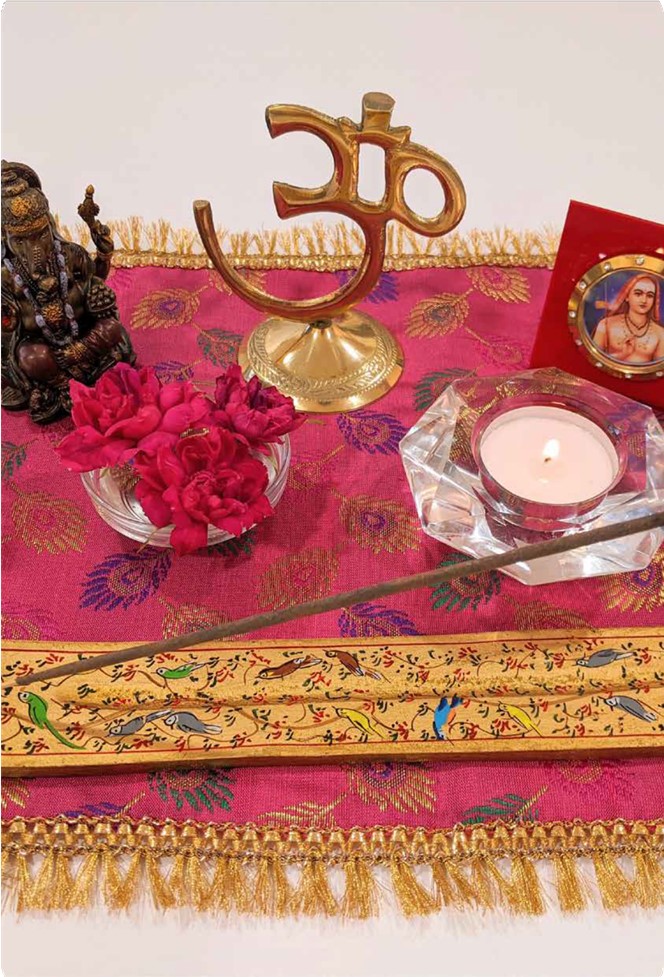
From your altar, positive energy will radiate out into the rest of your home.
An altar will inspire you and remind you not to forget your spiritual practice.
And when you feel exhausted, depressed or hurt by the ways of the world, just sitting in front of your altar will comfort you and fill you with new strength and positivity.
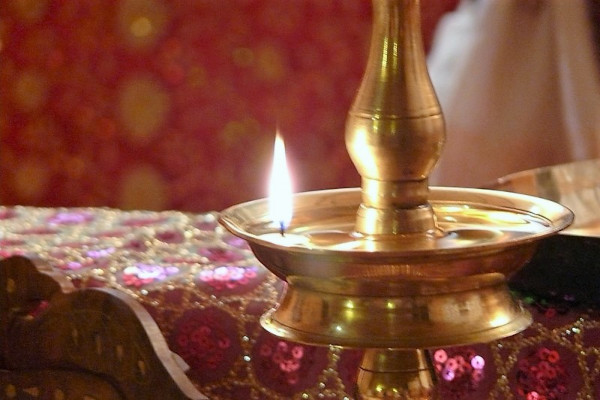
Arati is the yogic light ceremony to purify and uplift the vibratory level of any place. It combines the purity and positivity of light with the purity and positivity of Mantras.
Lights also represents our Supreme Self or the Divine. We remember our true Self during Arati.
Arati is especially helpful to counteract negative or disturbing energies – for example after renovations in your home, an awkward visit, a quarrel, etc.
But in fact, Arati should be done daily under any circumstances, just for the sake of uplifting and purifying your mind and your home.
The Sivananda Centres and Ashrams do Arati twice daily, morning and evening.
All over India, Arati is done in temples as highlight of a spiritual ceremony. The principle of waving light is always the same, but the mantras can be very different according to which aspect is invoked, for example during the Ganga Arati which is performed along the banks of the Ganges, Mantras praising Ganga are chanted.
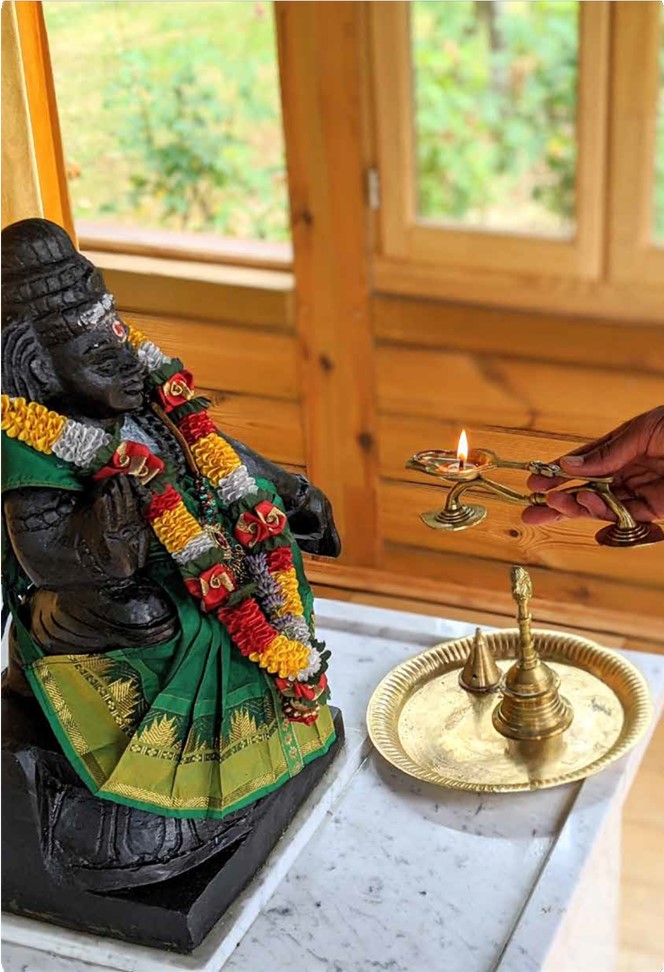
An Arati lamp or a tea candle on a little plate or an incense. The function of an Arati lamp is that you can hold it in your hand and wave it around while it is lit, so, any set up that fulfils this purpose will do.
A little bell: the sound of a bell drowns out worldly sounds and reminds us that time is precious and that we should use it to focus on the present moment and do Sadhana.
Prasad as an offering (fresh fruits or sweets or dried fruits like raisins).
What you use for Prasad should be used only for Prasad, don’t taste it before it is offered at the altar and don’t use leftover fruits (like half a banana). You can for example keep a little bag of raisins close to your altar and each time take out only your daily portion needed for Arati.
The meaning of Prasad: literally “Grace”. It represents a selfless act – we offer, instead of taking, thus purifying the heart. Symbolically it also means offering the fruits of our actions to the Divine.
Practical effect: Prasad is kept during Arati at the Altar and gets charged with the positive energy of light and the mantras of the Arati and then afterwards we eat this positivity by eating Prasad.
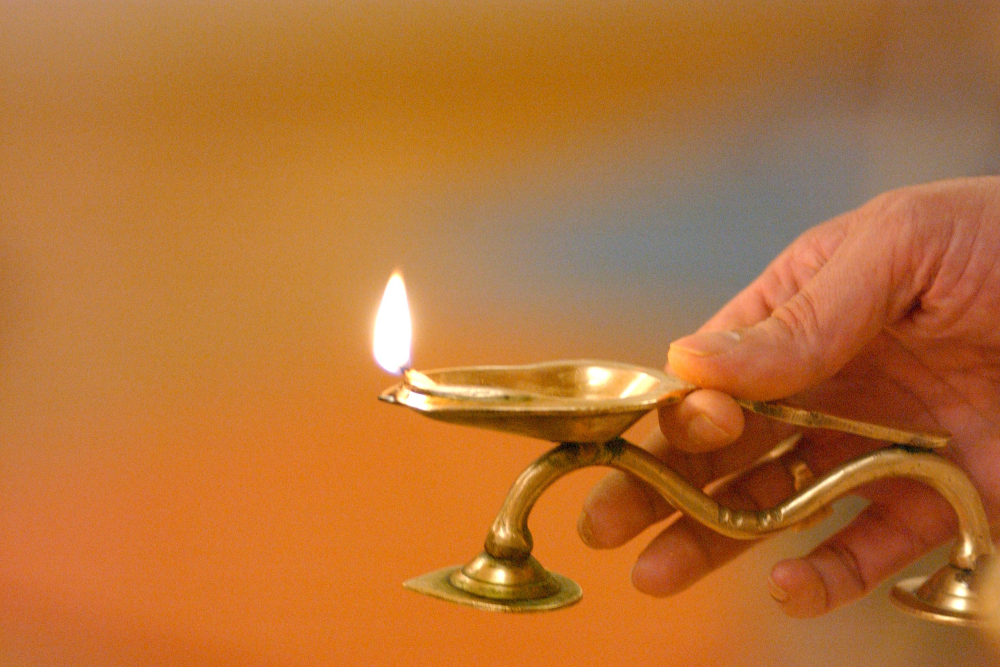
Here a simple, but powerful version:
Then you can select the Mantra(s) of the deity/deities that you have on your altar and chant some or all of them, each three times:
If you have a spiritual Master, chant his/ her name as well, for example, if you feel connected to Swami Sivananda, chant three times:
Wave a lit incense clockwise and chant a few times “Om Om Om” before offering the light of the incense to the altar.
The full Arati that is chanted during the Satsangs at the Sivananda Centres is quite long, since in the universal spirit of Yoga it invokes many forms and manifestations of the Divine.
